Unified Payments Infrastructure | Hoverla Soft
We built a provider-agnostic platform that connects fiat, crypto, liquidity providers, wallets, rates and transaction tracking through one portal and one API.
technologies
Industry
Fintech / Crypto Infrastructure
Country
United Arab Emirates
Project State
Started on July, 2025
Team
3 developers & 1 project manager
The challenge
When a business wants to send money internationally, the current setup is a fragmented landscape consisting of various banks, crypto providers, liquidity partners, payment rails, currencies and blockchain networks, all with their own integration logic, fees, settlement rules, reporting format and operational risks. This fragmented and complex system is time consuming, expensive and unpredictable for large scale operations and fintechs who are forced to integrate with multiple providers in multiple jurisdictions and reconcile disparate transaction data. BloxFi aims to simplify this by providing businesses with a unified on-ramp, off-ramp, fiat exchange and crypto swap solution that requires a single integration point.
The solution
NestJS Backend
Built to support complex fintech logic, provider integrations, transfer workflows, wallets, rates, permissions and admin operations in one structured backend system.
React Client Portal
Developed to give business users a clear self-service experience for quotes, wallets, beneficiaries, transfers, transaction history and real-time status tracking.
Partner API
Created as a public REST API with API-key authentication, OpenAPI documentation, webhooks and a consistent contract for external fintech integrations.
Provider Connector Layer
Designed to normalize different provider APIs, rate formats, statuses, webhooks, limits, fees and network rules behind one internal model.
Redis Queues and Circuit Breakers
Used to process asynchronous provider events, poll transaction statuses, manage background jobs and isolate provider failures without affecting the whole platform.
AWS Infrastructure
Set up with containerized deployment, CI/CD, cloud logging and scalable services to support a production-ready fintech platform.
Core features
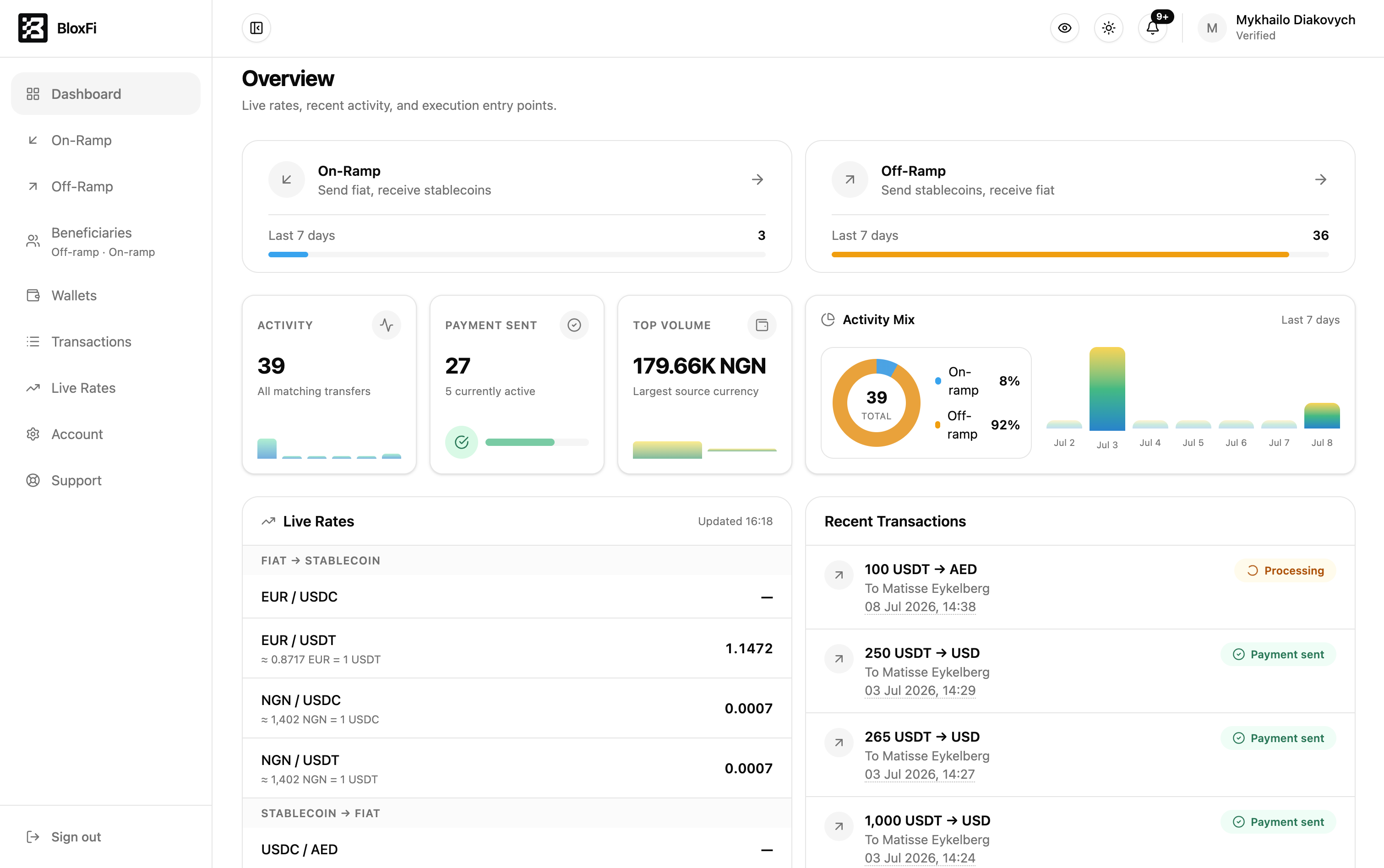
Unified On-Ramp and Off-Ramp Portal
Let businesses buy and sell stablecoins through one clean workspace, with wallets, beneficiaries, live rates, transfer history and transaction tracking in one place.
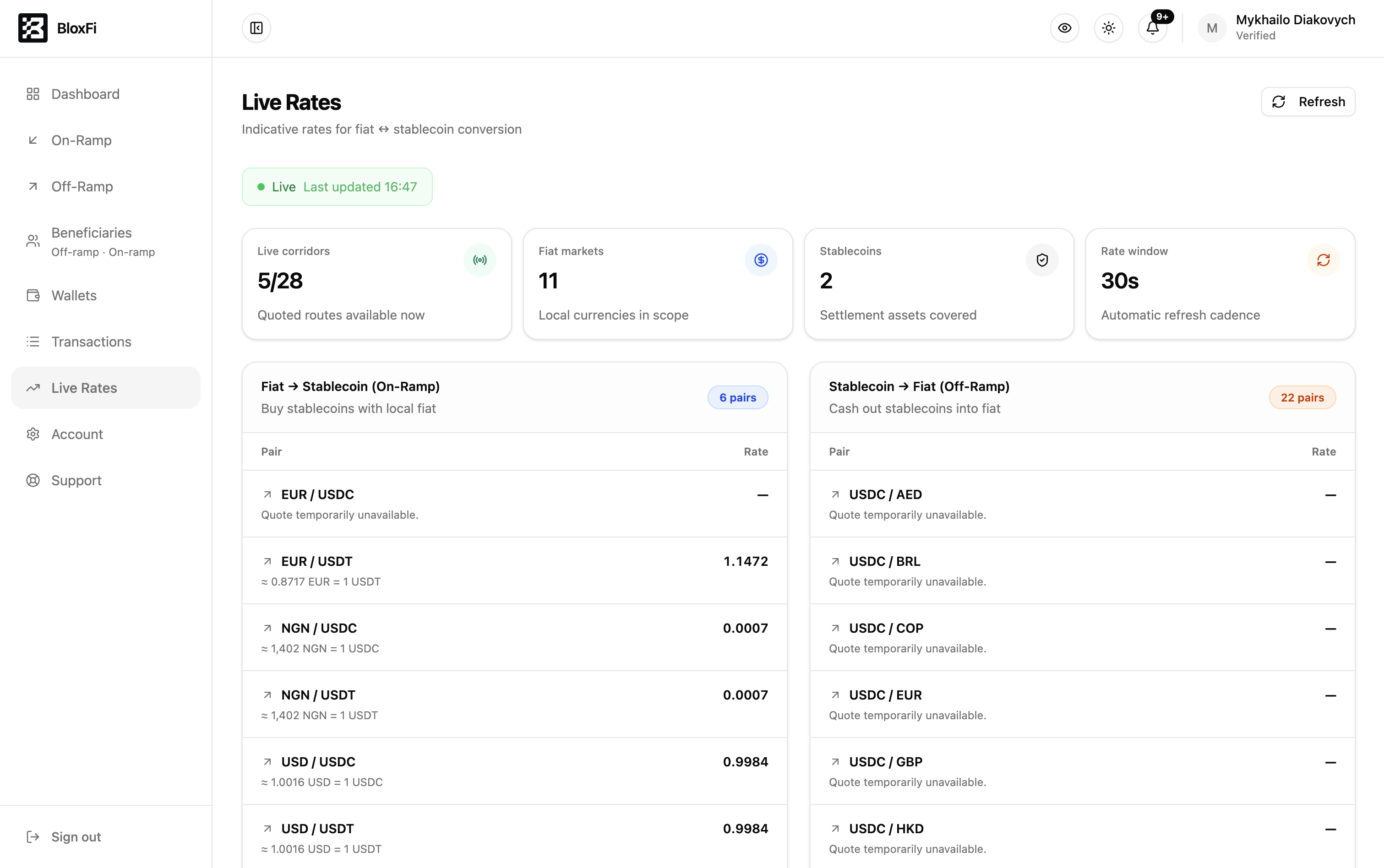
Real-Time Quotes and Live Rates
Show available fiat & stablecoin corridors, live quote availability, bid/ask pricing, supported markets, and automatic refresh windows before a transaction is created.
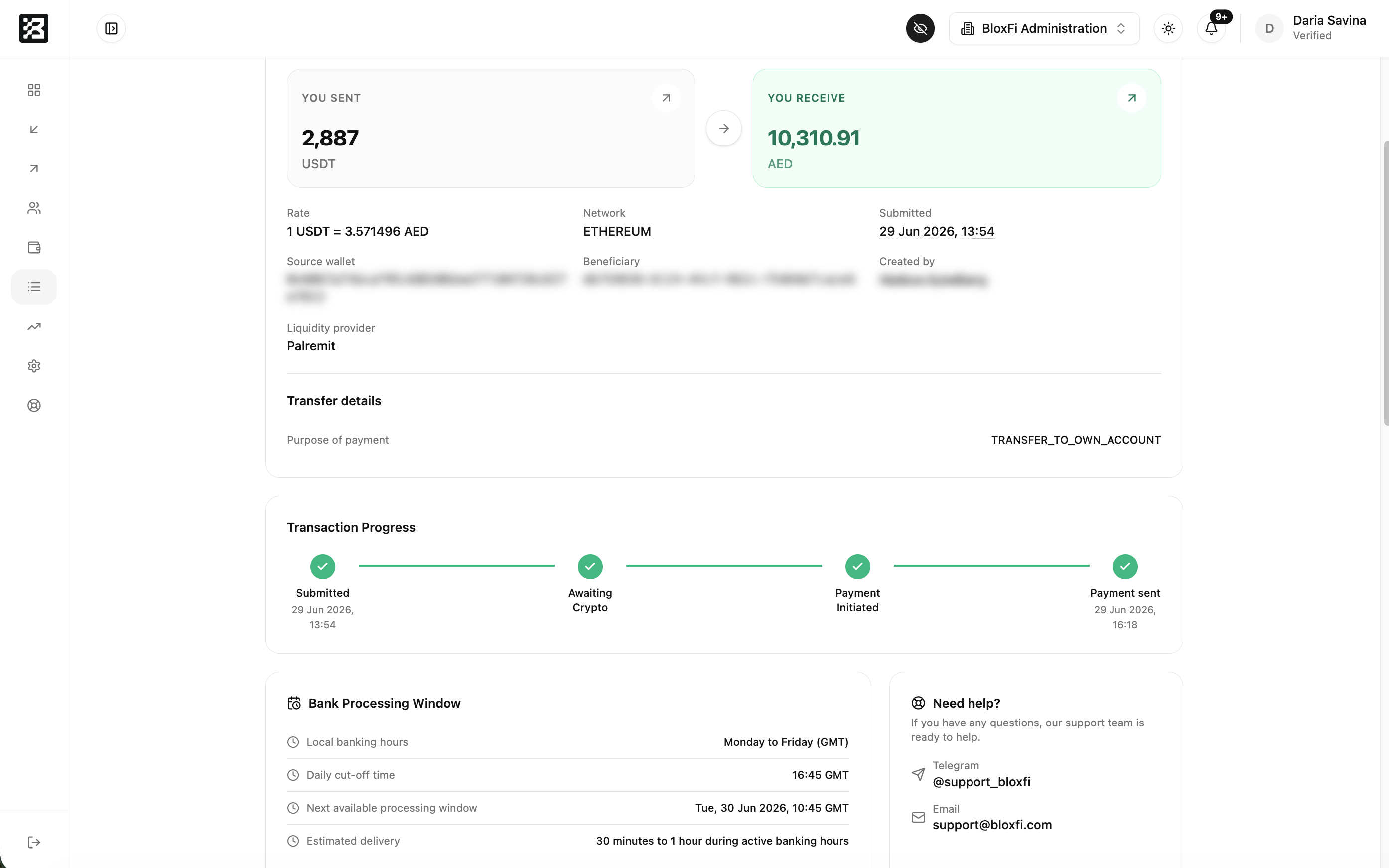
Transfer Tracking and Status Timeline
Give clients full visibility into each transfer: amount sent, amount received, rate, network, beneficiary, provider, processing window and transaction progress.
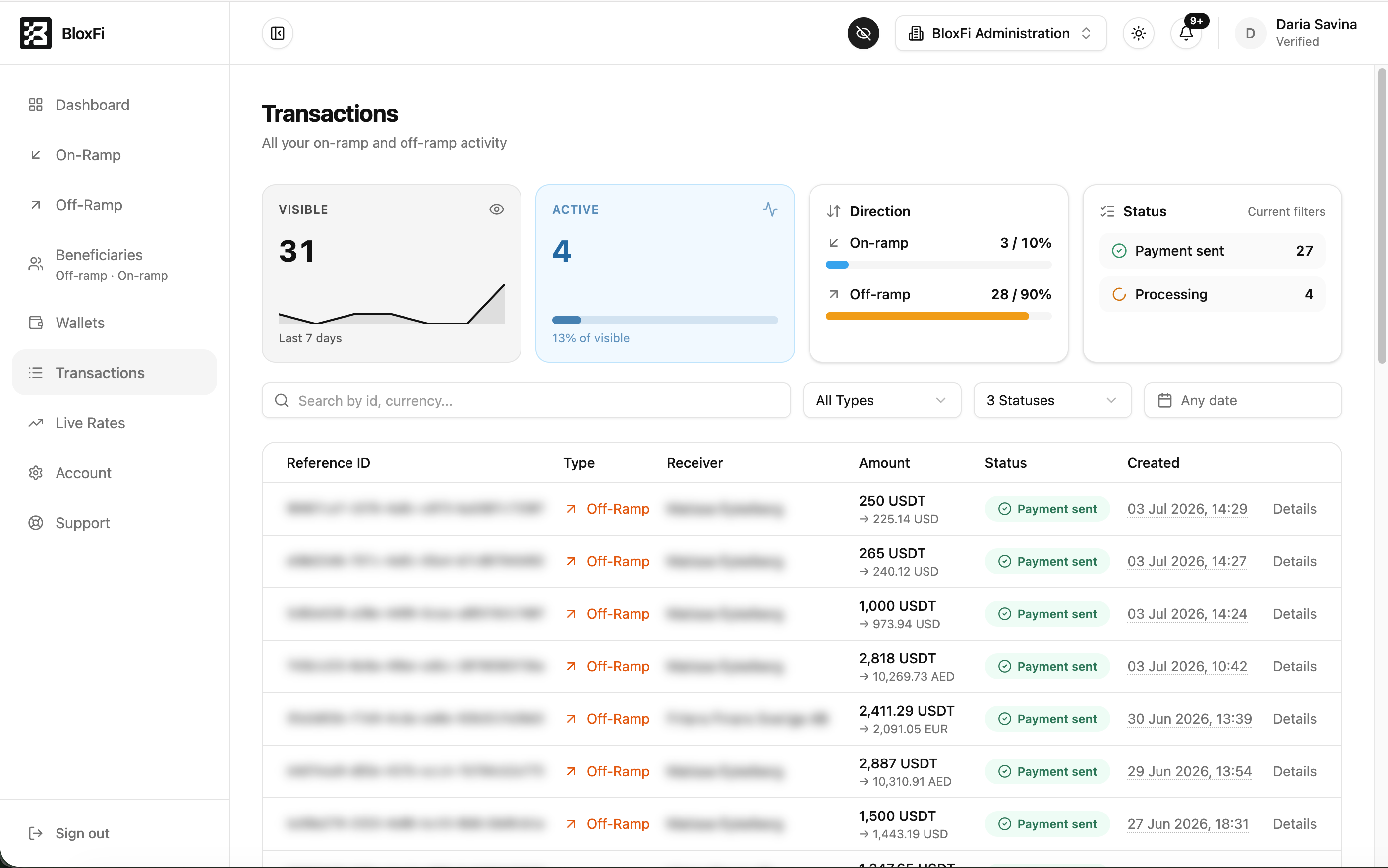
Transaction Operations Workspace
Help business users search, filter, and monitor on-ramp/off-ramp activity by type, status, date, amount and transaction state.
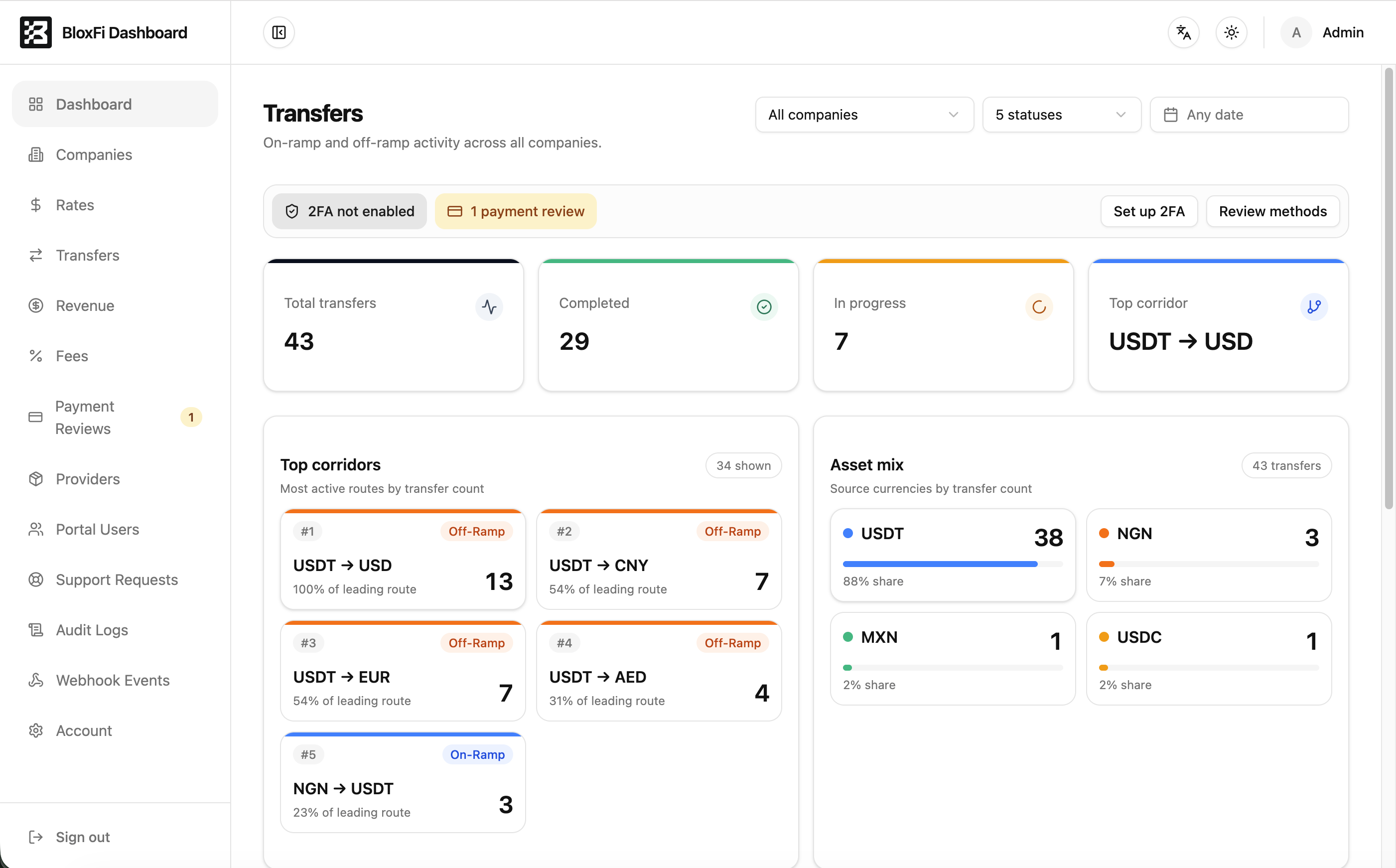
Admin Analytics Dashboard
Give internal teams a high-level operational view across companies: transfer volume, completion rate, active transfers, top corridors, direction mix and status health.
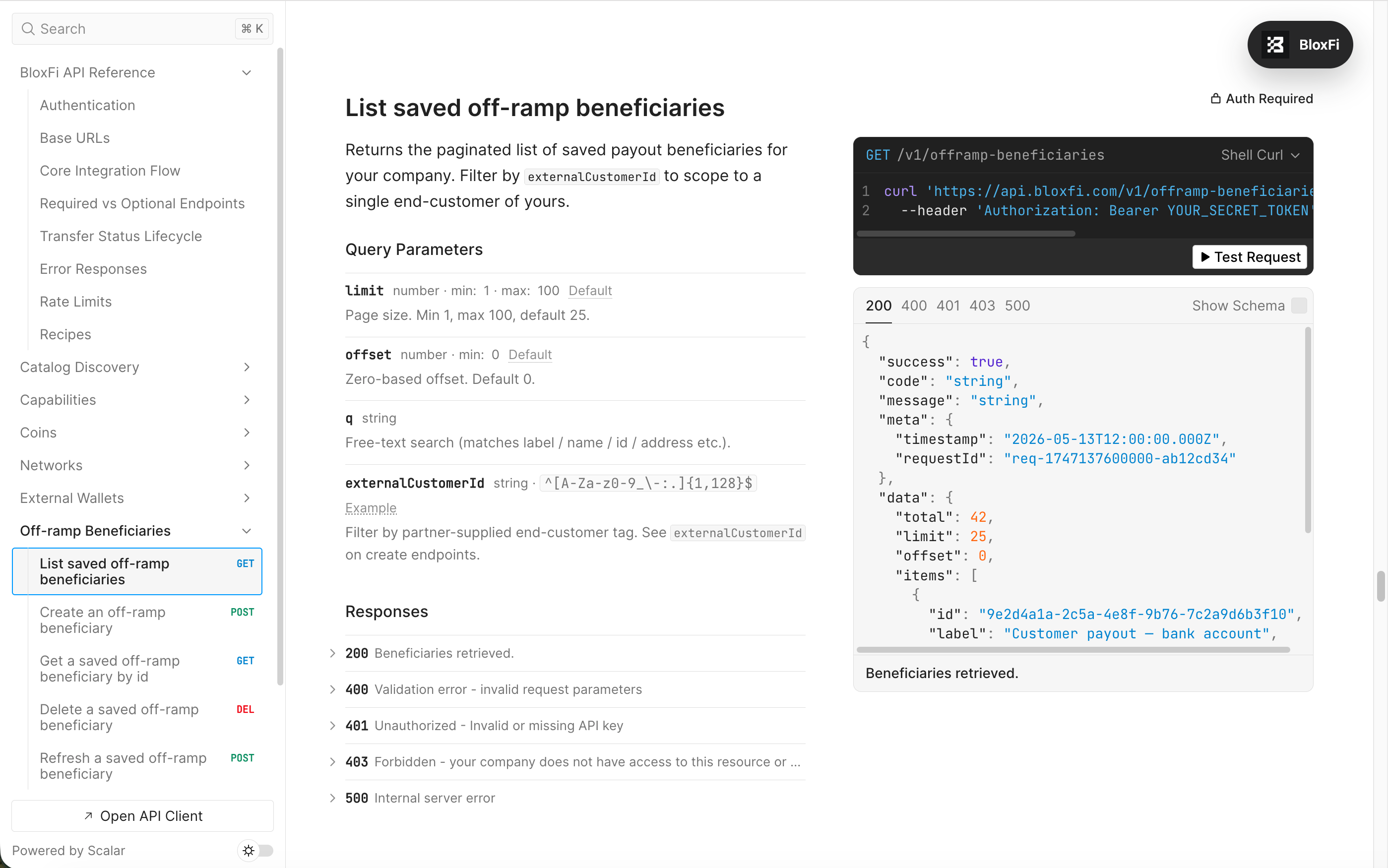
Client API for Business Integrations
Allow business clients to integrate BloxFi flows directly into their own products through API endpoints for beneficiaries, wallets, live rates, quotes, transfers, webhooks and reconciliation.
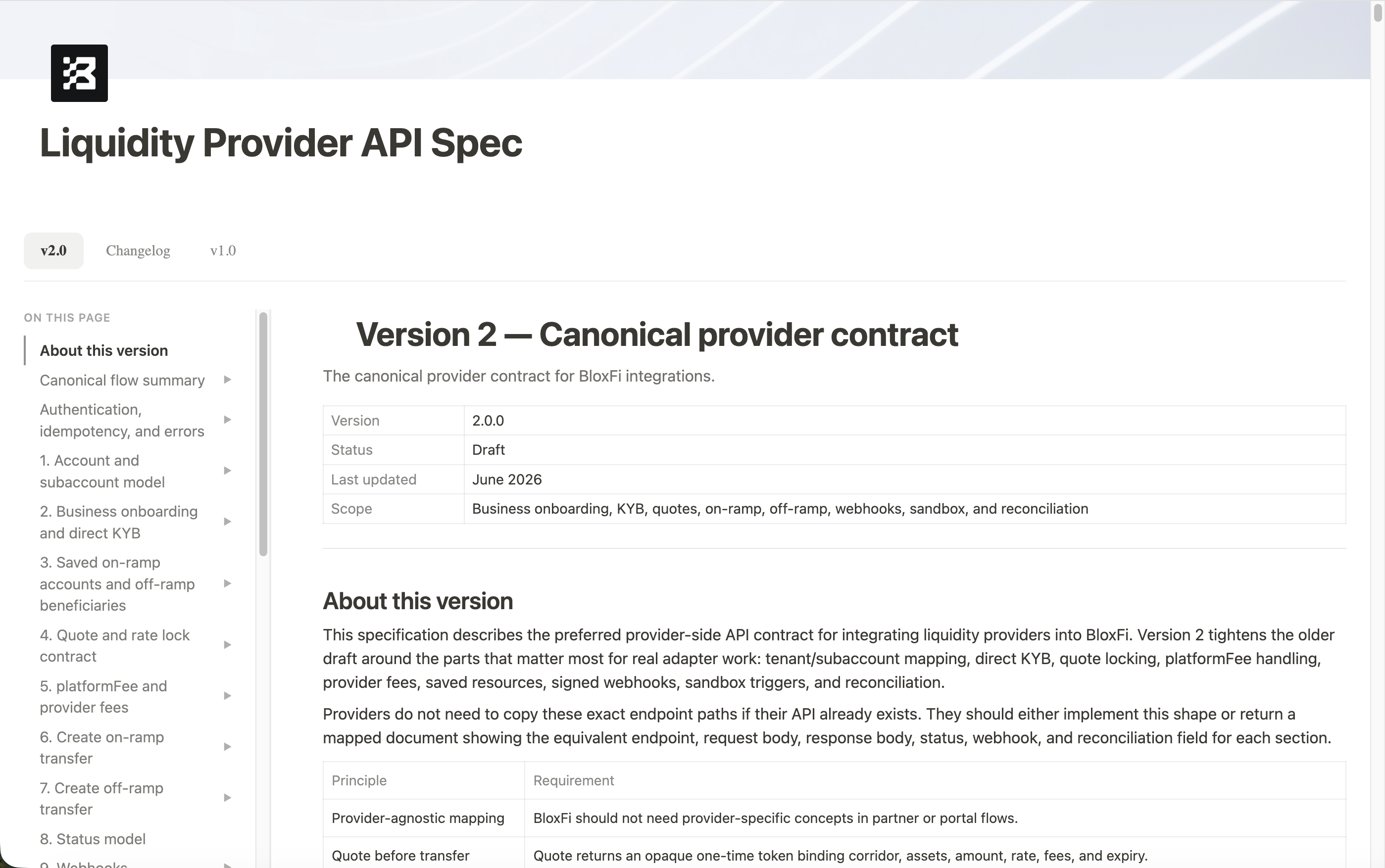
Provider Integration Layer
Standardize how liquidity providers connect to BloxFi, including quote delivery, quote locking, rate execution, transfer creation, webhook updates, fees and reconciliation.
Implementation
We approached BloxFi as a full product ecosystem, first simplifying the core money movement logic and then building the portal, API, admin tools and provider integrations around one clear technical foundation.
Product Architecture
Designed the core architecture for a multi-surface platform: client portal, admin console, partner API, landing page and provider connector layer.
Backend and Workflow Logic
Built the backend with structured business logic for quotes, wallets, beneficiaries, transfers, provider access, transaction statuses and operational workflows.
Partner API Development
Created a public API with API-key authentication, OpenAPI documentation, webhooks and a consistent contract for external fintech integrations.
Provider Connector Layer
Developed a modular integration layer to normalize different provider APIs, rates, fees, statuses, webhooks and network rules under one internal model.
Client Portal Development
Built a self-service portal where business clients can request quotes, manage wallets and beneficiaries, create transfers and track transaction progress.
Admin Console and Operations
Created an internal dashboard for managing companies, API keys, provider access, fees, payout rails, transfer statuses, audit logs and support requests.
Infrastructure and Reliability
Set up AWS-based infrastructure, deployment workflows, queues, caching, logging, polling, webhooks and circuit breaker logic to support stable transaction processing.
What stood out about Hoverla Soft was their ability to handle both the product and technical complexity of a fintech platform end-to-end. The team was not limited to development only. They helped shape the architecture, design the user flows, build the core product layers and think through integrations, scalability and operational needs. Their approach felt structured, practical and deeply involved in the product, not just in writing code.

Matisse Eykelberg
Founder and CEO at BloxFi
Outcome
BloxFi received a working fintech platform that combines the client portal, admin console, partner API, provider connector layer, AWS infrastructure and API documentation in one ecosystem.
The platform gives businesses one API for on-ramp, off-ramp, wallets, rates, transfers and transaction tracking instead of separate integrations for each provider.
BloxFi received a scalable provider-agnostic foundation for expanding across new liquidity, payment and crypto providers without rebuilding the core platform.
The platform is ready to support real transaction flows, including quote generation, transfer creation, webhook updates and end-to-end transaction status tracking.